
Custom aquarium room dividers are transforming luxury residential design in Los Angeles.
At Fish By Design, we’ve installed dozens of luxury aquarium room dividers throughout Southern California, from Newport Coast estates to Beverly Hills residences. As premier custom aquarium builders, we specialize in creating primary architectural features that shape how spaces function and feel. When designed and installed correctly, they deliver benefits that no conventional room divider can match.
In This Article
- The Architectural Advantages of Aquarium Room Dividers
- Learning from Successful Installations
- Design Considerations for Room Divider Aquariums
- Technical Requirements and Integration
- The Impact on Spatial Experience
- Maintenance and Long-Term Considerations
- Integration with Interior Design
- Why Reef Systems Excel as Room Dividers
- The Design Process for Architects and Builders
- Making the Case to Clients
- FAQs about Aquarium Room Dividers
The Architectural Advantages of Aquarium Room Dividers
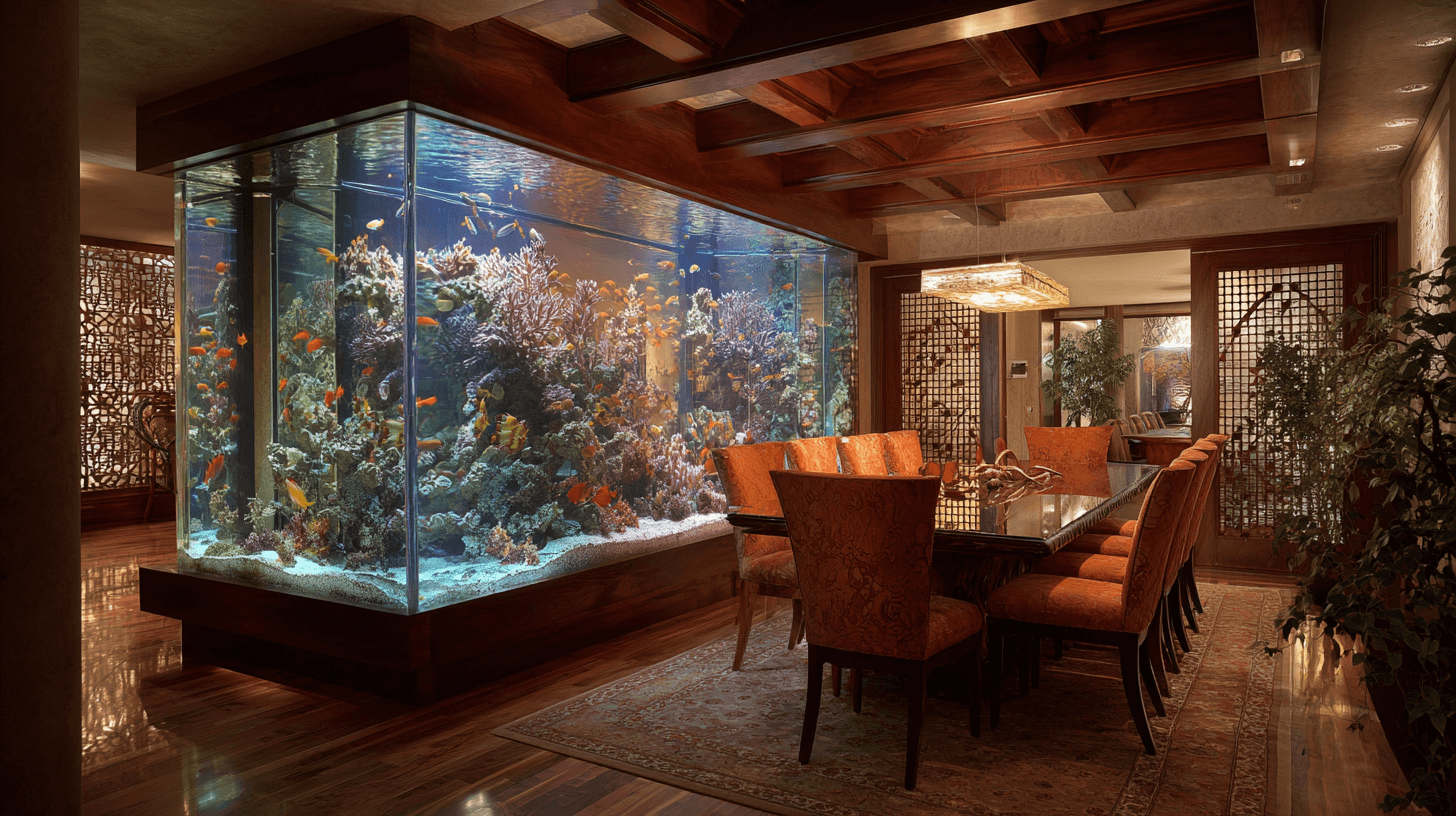
Large-scale reef aquarium serving as architectural room divider
A well-designed aquarium room divider accomplishes what seems contradictory: it separates spaces while maintaining visual connection. Standing in a dining room and looking through a 700-gallon reef aquarium into the living area beyond, you experience spatial definition without isolation. The effect is dramatic, sophisticated, and uniquely suited to the open floor plans that define contemporary luxury homes.
Light transmission is perhaps the most underappreciated benefit. Traditional solid dividers block natural light, requiring additional lighting in interior spaces and creating shadows that can make areas feel smaller. Aquariums, by contrast, allow light to pass through while adding their own ambient illumination. The result is spaces that feel larger, brighter, and more connected to the home’s overall flow.
The dynamic nature of aquariums as architectural elements sets them apart from any static divider. A living reef changes throughout the day—coral polyps extend and retract, fish move in patterns influenced by feeding times and light cycles, subtle water movement creates ever-shifting reflections. This living architecture engages viewers in ways that no static installation can, creating focal points that reward sustained attention while never demanding it.
For architects designing luxury homes, aquarium dividers offer a signature element that immediately distinguishes the space. In a market where high-end buyers have seen countless open floor plans, exposed beams, and designer finishes, a stunning room divider aquarium becomes a memorable feature that sets the property apart. According to the American Institute of Architects, innovative spatial solutions that maintain visual flow while defining distinct zones are increasingly valued in luxury residential design. It’s the detail that appears in listing photos, that guests remember, and that homeowners identify as a defining element of their space.
Learning from Successful Installations
Our Ghreiwati Project in Newport Coast demonstrates the power of this approach. The 700-gallon mixed reef aquarium serves as the primary divider between the main living areas, establishing spatial zones while maintaining the home’s sense of openness. Viewable from multiple sides, the aquarium creates different experiences depending on your perspective—the dining area features the front-facing view showcasing the aquarium’s full depth and dimension, while the living area offers a side-angle view that emphasizes the length and movement within the ecosystem.
The structural requirements for this installation were substantial. The aquarium, when fully installed with water, substrate, rock work, and equipment, weighs approximately 7,000 pounds. The floor system was engineered specifically to support this concentrated load, with reinforced joists and support beams that distribute weight safely. Because this planning happened during the home’s design phase, the structural provisions were invisible—there are no exposed beams, no visible reinforcement, just a seamlessly integrated architectural element that appears to float effortlessly in space.
Our Coto de Caza Project, featuring a 350-gallon mixed reef, offers a different perspective on the room divider concept. In a slightly smaller application, the aquarium provides effective spatial definition without overwhelming the space. The scale is perfectly calibrated to the room dimensions—large enough to make a statement and effectively separate areas, but proportioned to maintain balance with the surrounding architecture. View more examples of our completed installations in our project portfolio.
Both installations incorporate remote filtration systems, with equipment housed in dedicated mechanical rooms out of sight. This is critical for room divider applications where the aquarium is viewable from multiple angles. There’s no back side to hide equipment, no wall to conceal plumbing—everything must be integrated invisibly into the floor system or routed to remote locations. This level of integration requires careful coordination between Fish By Design, the architect, and the construction team, but the result is worth the effort: a clean, sophisticated installation with no visible compromises.
Design Considerations for Room Divider Aquariums
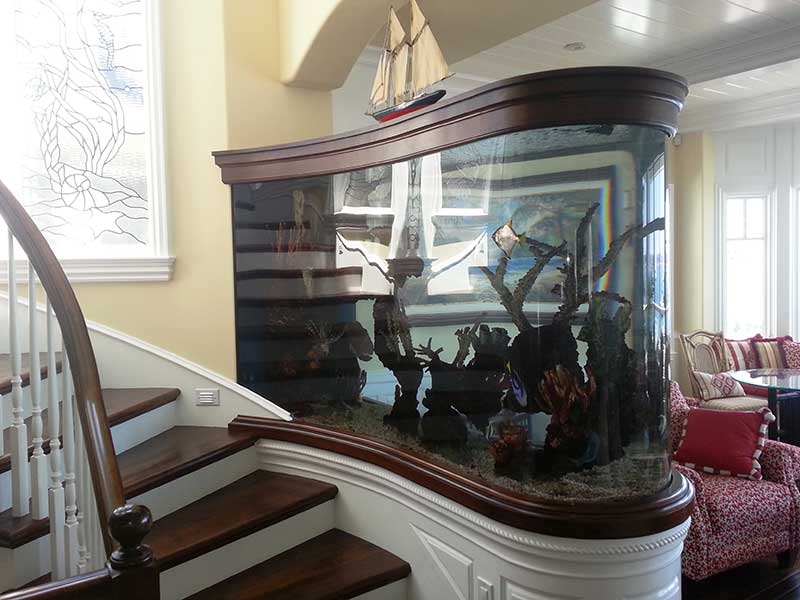
Aquascape designed for optimal viewing from multiple angles
The first consideration for any aquarium design is sight lines. Unlike wall-mounted or alcove installations where viewing happens from one primary direction, room dividers demand consideration of multiple viewing angles. What works visually from the dining room must also work from the living area, and potentially from connecting hallways or adjacent spaces.
This influences everything from the aquascape design—the arrangement of rock work and coral—to the technical systems. Reef aquascaping for room dividers typically features central structures that create visual interest from any angle, with coral placement that avoids dead zones or awkward empty spaces when viewed from different positions. The goal is an installation that reveals different aspects of the ecosystem depending on your viewing position, maintaining interest from every angle.
Lighting design becomes more complex with multi-directional viewing. The lighting system must illuminate the aquarium effectively for all viewing angles without creating glare or hot spots. We use specialized LED systems that can be programmed for different zones within the aquarium, ensuring even illumination that flatters the installation from every perspective. The lights themselves must be integrated invisibly—when you look up at the aquarium, you should see the water surface and perhaps subtle lighting effects, not fixtures or hardware.
Scale and proportion require careful attention. An aquarium that’s too small fails to effectively divide space and feels like an afterthought rather than an architectural element. Too large, and it dominates the space in ways that can feel overwhelming or limit furniture placement and traffic flow. We work with architects to determine optimal dimensions based on ceiling height, viewing distances, and the specific spatial requirements of the adjoining areas.
As a general guideline, effective room divider aquariums in luxury residential applications typically range from 300 to 1,000 gallons, with dimensions that relate thoughtfully to the scale of the spaces they’re dividing. A 10-foot ceiling height comfortably accommodates an aquarium 6 to 7 feet tall, creating strong visual presence without appearing cramped. Length depends on the width of the space being divided, but installations between 8 and 16 feet long offer flexibility for furniture arrangement while maintaining effective spatial definition.
Technical Requirements and Integration
The structural engineering for room divider aquariums differs fundamentally from wall-mounted or built-in installations. Without surrounding walls to help support the load, all weight must be carried by the floor system below. This typically requires steel support beams, reinforced joists, or in some cases, support columns that extend to the foundation. These structural provisions must be designed into the home from the beginning—retrofitting this level of support into existing construction is expensive and often impractical.
The aquarium itself must be engineered as a freestanding structure. While it may appear to float in space, it’s actually supported by a carefully designed base structure that distributes weight appropriately and provides access for plumbing connections. This base can be finished to match the home’s flooring or designed as a distinct architectural element—perhaps a stone plinth or architectural metalwork that becomes part of the installation’s visual character.
Plumbing and electrical systems must be routed invisibly through the floor to remote equipment locations. This is where coordination between Fish By Design and the construction team is critical. During rough-in, we specify exact locations for plumbing penetrations, electrical conduits, and any other connections that must pass through the floor system. These provisions are incorporated into the construction process, appearing in the final installation as invisible connections that maintain the clean, architectural character of the design.
Equipment rooms for room divider installations typically need to be located within 20 to 30 feet of the aquarium to maintain efficient water circulation. Basements, garages, utility areas, or dedicated mechanical spaces all work well. The key is providing adequate space (typically 50 to 150 square feet depending on aquarium size), drainage, electrical service, and ideally climate control. These spaces become the invisible infrastructure supporting the architectural feature that everyone sees.
The Impact on Spatial Experience
Beyond the technical considerations, what makes aquarium room dividers compelling is how they affect the lived experience of the space. They create what designers call “soft boundaries”—clear spatial definition that doesn’t feel like separation. You’re aware of being in distinct zones, but you remain connected to the larger space and the people in it.
This quality makes aquarium dividers particularly effective in homes designed for entertaining. A formal dining area separated from the living room by an aquarium maintains its distinct character—guests at the table experience the intimacy of a defined dining space. Yet the visual connection through the aquarium prevents the isolation that solid walls would create. Conversation flows naturally between spaces, and the ambient movement and light from the aquarium create a dynamic backdrop that enhances the dining experience without overwhelming it.
The psychological impact of water and aquatic life adds another dimension. Research consistently shows that viewing aquariums reduces stress and promotes relaxation. A room divider aquarium becomes a living meditation in the center of the home—a calming presence that influences the character of both spaces it touches. This effect is subtle but cumulative, contributing to the overall sense of tranquility and luxury that defines exceptional residential design.
Children and guests are inevitably drawn to these installations. They become natural gathering points, conversation starters, and sources of ongoing fascination. This social dimension shouldn’t be overlooked when considering architectural features for high-end homes—elements that create engagement and encourage interaction add value beyond their purely aesthetic or functional contributions.
Maintenance and Long-Term Considerations
Room divider aquariums require the same regular maintenance as any large installation—water testing, cleaning, coral health monitoring, and equipment service. The difference is access. Without a back side to work from, maintenance must be carefully planned to be efficient and unobtrusive.
We design room divider installations with specific maintenance provisions. Removable access panels in the top structure allow technicians to reach into the aquarium for routine cleaning and coral maintenance. Remote filtration means major equipment servicing happens out of sight in mechanical rooms, not in primary living spaces. Water changes and additions are plumbed to the equipment room, so maintenance activities don’t disrupt the spaces surrounding the aquarium.
For homeowners, this typically translates to weekly or biweekly maintenance visits where our technicians arrive, perform all necessary service, and depart without any disruption to household activities. The aquarium itself remains pristine—clear water, healthy coral, algae under control—without any visible maintenance effort. This invisible service is essential for room divider applications where the aquarium is constantly on display from multiple viewing angles. Learn more about our professional aquarium maintenance services.
The long-term value proposition of aquarium room dividers is compelling. Unlike most architectural features that remain static, aquariums actually improve over time as coral grows and the ecosystem matures. A well-maintained reef aquarium becomes more impressive in year three than in year one, more stunning in year five than year three. This progression creates increasing value rather than the depreciation that most home features experience.
Integration with Interior Design
Room divider aquariums must work harmoniously with the home’s overall design language. This means considering color palettes, material selections, and stylistic character during the planning phase. The aquarium itself provides blue and white tones from water and lighting, plus the organic colors of coral and fish. These must complement or contrast appropriately with surrounding finishes and furnishings.
The structural elements supporting the aquarium—the base structure, any framing or trim, and integration details—should relate to the home’s architectural character. In a contemporary home with clean lines and minimal detail, the aquarium structure might be refined and simple, perhaps incorporating the same materials used elsewhere in the space. In a more traditional setting, the base might feature stone or detailed millwork that relates to architectural elements in adjacent areas.
Furniture placement in spaces defined by aquarium dividers requires thoughtful consideration. Seating areas should take advantage of views into the aquarium without placing furniture so close that maintenance becomes difficult. Dining tables can be positioned to offer all guests views of the installation, creating a shared focal point that enhances the dining experience. Traffic flow through and around the spaces must be maintained, ensuring the aquarium divider enhances functionality rather than compromising it.
Why Reef Systems Excel as Room Dividers
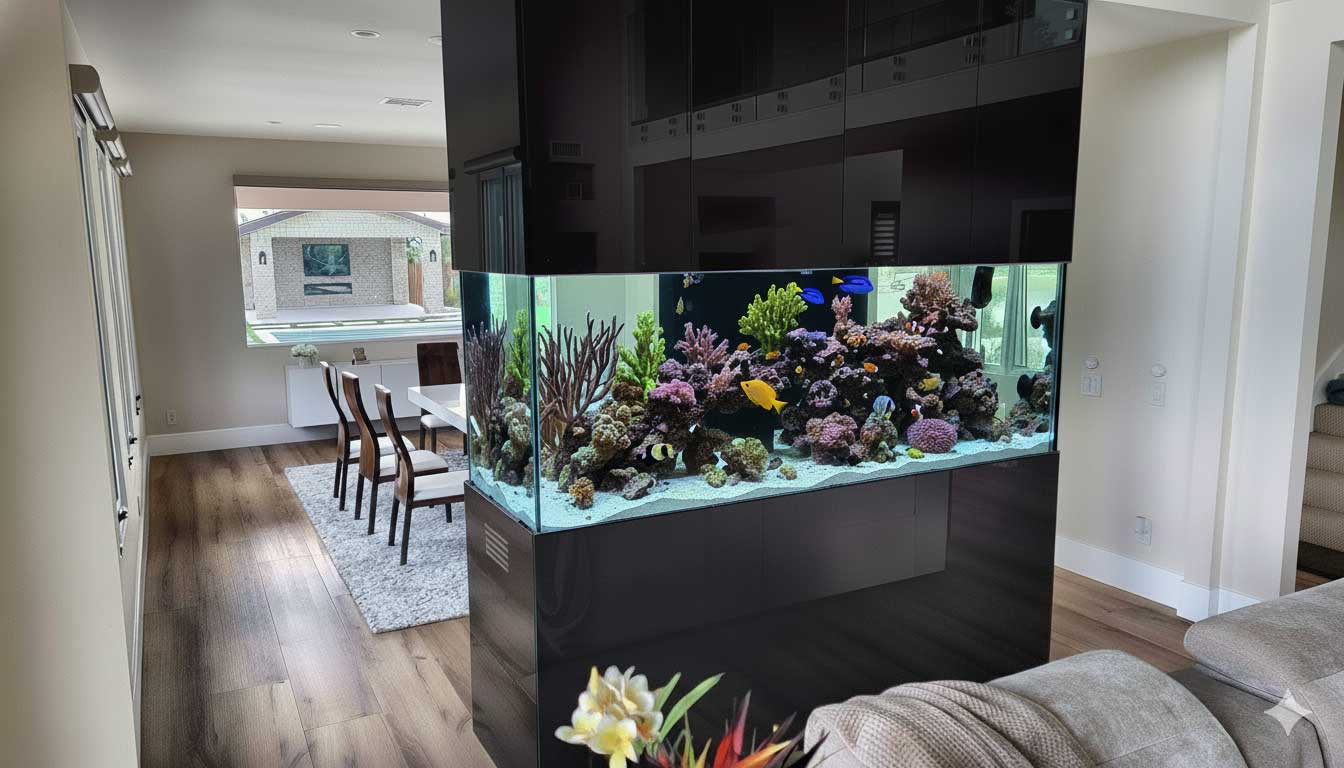
Vibrant coral colors create dramatic visual impact in reef systems
While freshwater aquariums can certainly function as room dividers, reef aquarium designs offer distinct advantages that make them particularly well-suited to this application. The color range in reef aquariums far exceeds what’s possible with freshwater—vibrant corals in blues, purples, greens, pinks, and oranges create visual interest that freshwater plants and fish can’t match. This color diversity ensures the aquarium remains engaging from all viewing angles, with different coral colonies creating distinct focal points depending on perspective.
The three-dimensional structure of reef aquascaping works ideally for multi-directional viewing. Coral colonies grow in complex forms that create visual interest from any angle, with depth and layering that reveal different aspects of the installation as you move around it. Combined with the constant, subtle movement of fish navigating through coral structures and the gentle waving of coral polyps in the current, reef systems provide the dynamic visual quality that makes aquarium dividers compelling architectural features.
For luxury applications where making a distinctive statement is essential, reef aquariums deliver impact that freshwater installations struggle to match. They’re less common, more sophisticated, and more visually dramatic. When homeowners invest six or seven figures in a custom home, they want signature elements that reflect that investment. A stunning reef aquarium room divider communicates luxury and sophistication in ways that resonate with the expectations of high-end buyers.
The Design Process for Architects and Builders
For architects and contractors incorporating room divider aquariums into luxury home projects, the process begins during schematic design. This is when we can have the greatest impact, helping to shape the spatial concept and identify optimal locations that work structurally, mechanically, and aesthetically. Our complimentary design consultations help architects integrate aquarium requirements from the earliest planning stages.
We provide detailed specifications including exact dimensions, weight loads, structural requirements, plumbing and electrical needs, and equipment room specifications. These integrate into construction documents just like any other major building system. The structural engineer uses our load data to design appropriate floor support. The mechanical engineer coordinates equipment room requirements. The electrical engineer plans necessary circuits and controls.
During construction, our involvement follows a phased approach. We review framing to verify structural provisions, coordinate with plumbers and electricians during rough-in, and consult with millwork installers to ensure any finished elements integrate properly. The aquarium itself is typically installed after finish work is substantially complete, minimizing any risk to the installation during ongoing construction activities.
This coordinated process ensures the aquarium room divider becomes an integral part of the home rather than an added feature. It works seamlessly with all building systems, meets all structural and code requirements, and delivers the visual impact and spatial qualities that justify its inclusion in the design.
Making the Case to Clients
For architects and contractors, presenting the room divider aquarium concept to clients requires addressing both the opportunities and the investment. The upfront cost is substantial—large room divider installations typically represent five to six-figure investments. But the value proposition extends beyond the initial installation.
These features significantly differentiate properties in the luxury market. They become signature elements that appear prominently in listing materials, that buyers remember from showings, and that contribute to perceived value disproportionate to their cost. In a competitive luxury market, distinctive architectural features that can’t be easily replicated are valuable differentiators.
For homeowners planning to occupy the property long-term, the daily experience matters more than resale considerations. A room divider aquarium transforms how people experience their living space, adding a living, dynamic element that provides ongoing engagement and enjoyment. It’s not a feature that offers a thrill at installation and then fades into the background—it becomes more interesting over time as the ecosystem develops and matures.
The ongoing maintenance cost should be addressed transparently. Professional maintenance for large reef installations typically ranges from a few hundred to over a thousand dollars monthly, depending on system complexity and service frequency. For clients investing at luxury home price points, this represents a modest ongoing expense relative to the value and enjoyment the feature provides—roughly comparable to what they might spend on landscaping maintenance or pool service.
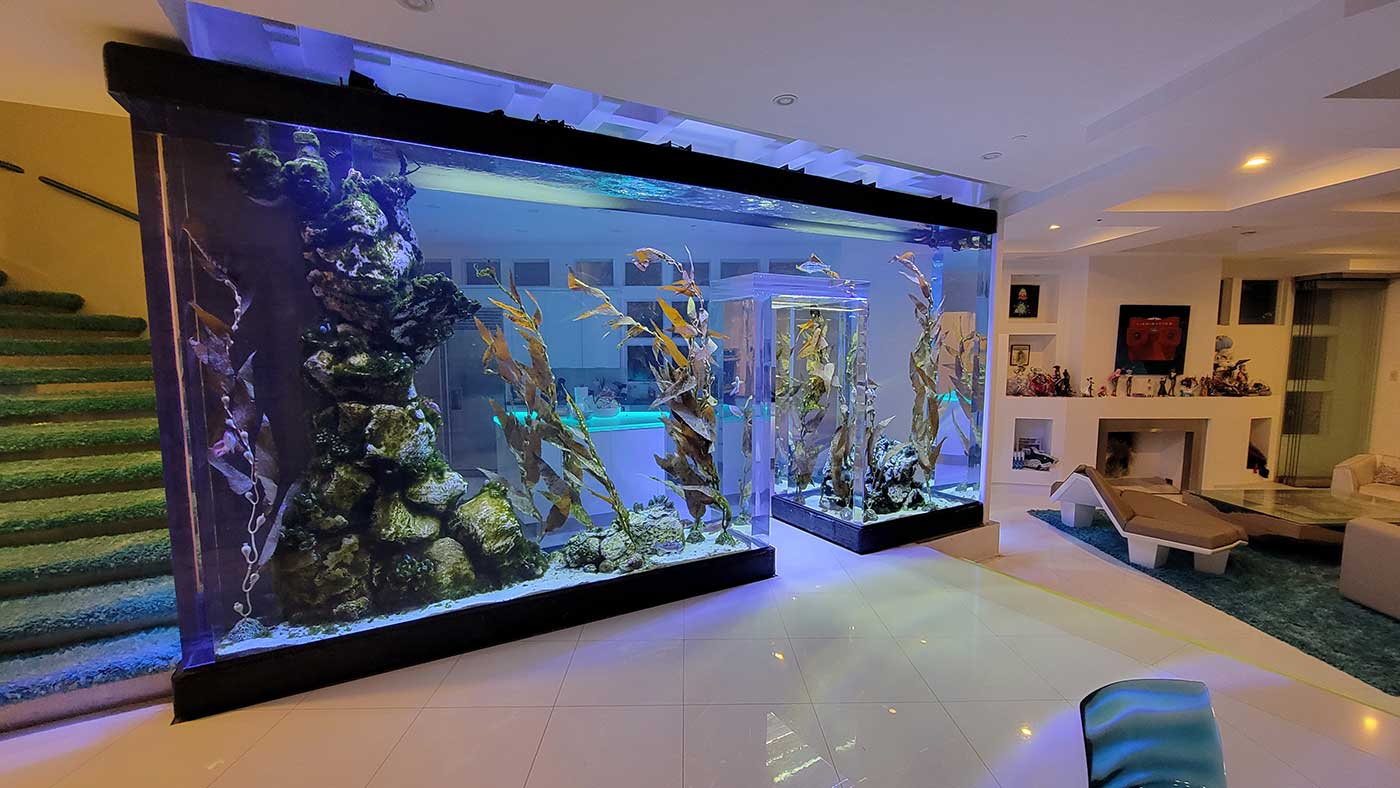
Completed room divider installation showcasing seamless architectural integration
Frequently Asked Questions
Explore Room Divider Options for Your Project
Fish By Design has extensive experience designing and installing aquarium room dividers in luxury homes throughout Los Angeles and Orange County.
Schedule a complimentary consultation to discuss how this architectural approach could enhance your current project:
Contact Us: Request Consultation
View Examples: See Our Portfolio
Service Areas: Beverly Hills to Newport Beach and throughout Southern California
About Fish By Design
For over three decades, Fish By Design has specialized in creating custom aquarium installations that serve as primary architectural features in Southern California’s finest homes. Our expertise in large-scale reef systems, combined with our deep experience collaborating with architects, contractors, and designers, ensures seamless integration of aquariums into luxury residential projects.
From design consultation through installation and ongoing maintenance, we provide comprehensive support that allows architects and homeowners to realize ambitious aquatic visions without compromising on quality, reliability, or aesthetic refinement.